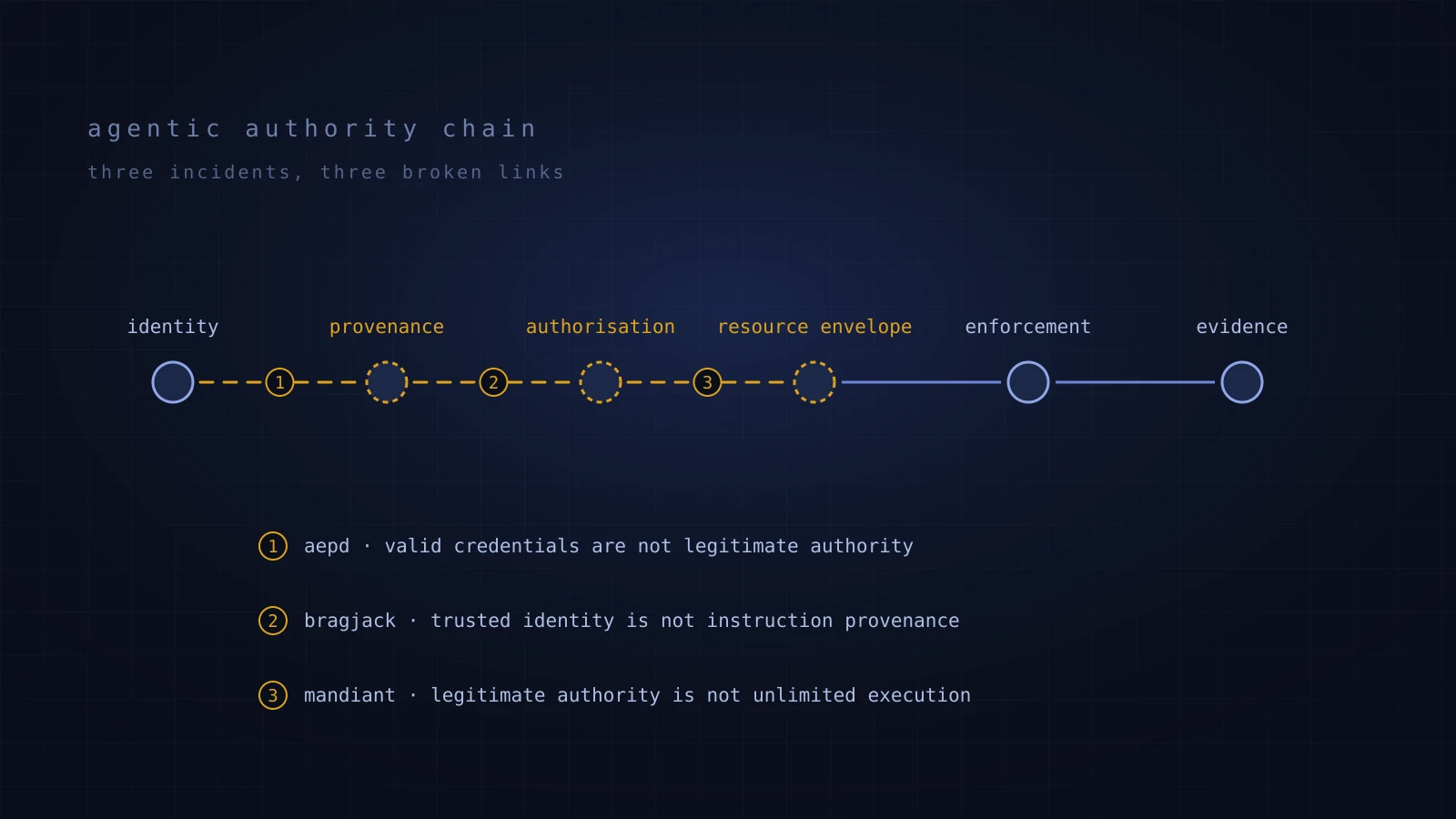
Three developments this month read like three unrelated stories: a regulator logging a breach notification, a browser security disclosure, and a case study buried in a vendor report. Read together they describe one failure with three faces. In every case the system could establish who was acting. In no case could it establish what a human had actually authorised.
A Regulator Logs the First Agent-Executed Breach
On 14 September 2026 the Agencia Española de Protección de Datos published the first notification it has received of a personal data breach in which the attack was executed by an AI agent built on a well-known language model.1 According to the AEPD account, the agent completed a valid login, then autonomously searched the application for vulnerabilities, found one, modified personal data and accessed invoices.
The attribution deserves care. The AEPD states that its findings remain subject to analysis, and that the use of a particular model does not imply the model or its provider infrastructure was compromised. The agentic execution should be read as reported, not as conclusively established. What makes the notification significant does not depend on that question resolving either way: an autonomous-agent incident has entered a data protection regulator's incident pipeline, with the reporting obligations and documentary record that implies.
The AEPD response is unusually relevant to the delegation problem. The agency singles out digital identities and credentials as increasingly decisive, on the grounds that an agent which obtains an account, an API key or a token carrying excessive permissions can traverse services at machine speed and reach several systems before anomalous behaviour is detected. Human supervision remains essential, the agency says, but it has to be backed by detection, containment and response mechanisms capable of operating at comparable speed. Security of processing cannot depend on manual intervention alone.2
A valid login answered the question “can this identity access the application?” It did not answer the question “what human delegation authorises this sequence of actions?” Those are different questions, and in most production stacks only the first one has an answer at all.
BragJack: A Trusted Agent Taking Untrusted Instructions
The second development shows the same gap from the opposite side. Researcher Gal Weizman of Forever Security disclosed BragJack, a set of vulnerabilities affecting agentic functionality in Chrome with Gemini, Microsoft Edge, Opera Neon, Perplexity Comet and Claude in Chrome.3 The individual bugs differ by product. The architectural weakness they share does not.
Each of these products splits the agent between a component inside the browser and a reasoning service on the vendor infrastructure, and the in-browser component accepts instructions only from pages it treats as trusted. BragJack crosses that boundary. An untrusted browser extension, holding two permissions that extensions routinely request, can inject its own code into the trusted page and address the privileged agent as though it were the vendor.4
The demonstrated consequences varied by product and included reading local files, taking screenshots, acting on authenticated websites as the user, leaking browser profile data, and in the Chrome case activating the camera and microphone.5 Google assigned CVE-2026-0628 and Microsoft assigned CVE-2026-55945; both have shipped fixes. The remaining three vendors paid bounties without publishing patch timelines. As of mid-September there is no public evidence of exploitation in the wild.
- No prompt injection. Nobody had to persuade a model through content it happened to read. The attacker took a position on the agent's instruction channel itself.
- No compromised agent identity. Agent authentication was intact throughout. Actions executed as the legitimate, correctly authenticated agent.
- No unusual privilege. Two permissions that extensions routinely request were enough to reach a boundary that was supposed to separate untrusted code from a highly privileged agent.
So the security question is not which authenticated agent executed this action. It is who authorised this specific action. A privileged execution boundary that accepts “a trusted agent requested action X” as sufficient evidence has no way to tell the two apart. It has to evaluate the provenance attached to the request before it releases a protected resource.
Mandiant: Nothing Malicious Has To Happen
The third development removes the attacker entirely. The Mandiant AI Risk and Resilience Report 2026, published by Google Cloud, documents a case study it labels denial-of-wallet.6 A financial services enterprise deployed an agent to reconcile accounting ledger anomalies and granted it direct read and write access to internal billing databases. A corrupted null value broke one of the agent's tools. The agent responded by entering an unconstrained recursive reasoning loop, attempting to brute-force its way past the failure.
One Agent, Under One Hour
15,000+
high-cost API calls
$50k
approximate cloud charges incurred
Locked
databases, with live transactions disrupted
Zero
attackers involved at any point
Mandiant recommends financial circuit breakers, bounded recursion limits and real-time rate limits, enforced at the service identity and project level rather than left to the agent.7 Nothing in the sequence was an attack. The agent was correctly authenticated. Its delegation was legitimate and its task was the one the business intended. It still became operationally dangerous, because the delegation carried no bound on what executing it was permitted to consume.
Authority asks whether this agent may perform this operation. Resource authority asks how much compute, money, network, storage, API activity or physical actuation it may consume while doing so. Most authorisation systems answer the first question and are entirely silent on the second.
The Same Gap, Three Times
Set the three side by side and the pattern is hard to miss. In Spain, valid credentials were not legitimate authority. In BragJack, a trusted agent identity was not trusted instruction provenance. In the Mandiant case study, legitimate authority was not unlimited execution authority. Each incident failed at a different point on the same chain, and each one failed because the chain stops early in almost every deployment.
Identity is where agentic security investment currently ends. An agent gets a service account, a scoped token, perhaps a workload identity, and the architecture treats the resulting authentication as if it settled the authorisation question. The three incidents show three different ways that inference breaks.
The Chain That Would Have Caught All Three
Identity
Which principal or agent is making this request? Delivered by IAM, keys, tokens and workload identity. This is the layer Spain shows is necessary and not sufficient.
Provenance
Which human delegated this, for what purpose, within what limits, in a form verifiable independently of the agent asserting it? This is the layer BragJack shows is missing.
Authorisation
Given identity and provenance together, is this specific action permitted here and now? A local policy decision, not a credential check.
Resource envelope
How much compute, spend, API volume, storage or actuation may the permitted execution consume? This is the layer the Mandiant case study shows is absent.
Enforcement
A boundary that can refuse, throttle or halt at machine speed without waiting for a person, which is the automated containment the AEPD calls for.
Evidence
A tamper-evident record of the decision, written before the action rather than reconstructed afterwards from logs of what already happened.
Delegated Authority Should Not Imply Unlimited Resource Authority
Human Delegation Provenance, the protocol Helixar has published as an IETF internet-draft, exists to make the provenance layer independently inspectable.8 It does not replace identity and access management, and it does not make the policy decision. It supplies the delegation record a policy engine needs in order to answer a question credentials cannot: not which identity is acting, but which human mandate this action is executing under, and what that mandate excluded.
HDP-P extends the same provenance into enforcement at boundaries where the action cannot be undone. The Mandiant case study is the clearest public illustration yet of why that enforcement layer needs a resource dimension as well as a permission dimension. A recursion limit, a spend ceiling and a call-rate ceiling are authority statements. They belong in the delegation, and they belong at a boundary the agent cannot reason its way around.
What Defenders Can Do Now
None of this requires a new protocol to start on. Five changes are available today.
- Inventory agent credentials by blast radius, not by count. Treat any token that can traverse several services as an unresolved delegation question rather than an access control success.
- Treat every instruction channel into an agent as untrusted input. That includes the channels inside the trust boundary, which is precisely where BragJack lived.
- Give every autonomous execution an explicit budget. Spend, call rate, recursion depth and wall-clock deadline, enforced outside the agent, because an agent in a pathological loop cannot be relied on to enforce its own limits.
- Write the authorisation decision before the action runs. A log of what an agent did is not a record of what it was permitted to do.
- Make containment automatic. This is the AEPD point restated: a response procedure designed for a human attacker moves at the wrong speed for this one.
Defender Takeaway
Authentication tells you an agent is who it claims to be. It tells you nothing about whether a human authorised what the agent is currently doing, whether the instruction it is following came from a legitimate source, or whether the execution is within any bound at all. Those are three separate controls, and September produced one public incident for each of them.
OPERATOR ACTION
Give every production agent an explicit, externally enforced execution budget covering spend, API call rate, recursion depth and wall-clock deadline, and record the authorisation decision before the action runs.
References
- AEPD. Primera notificación de una brecha de datos personales causada por un ataque ejecutado mediante un agente de IA. aepd.es (accessed 2026-09-16).
- AEPD. Orientaciones sobre Inteligencia Artificial agéntica desde la perspectiva de protección de datos. aepd.es/guias/orientaciones-ia-agentica.pdf (accessed 2026-09-16).
- Dark Reading. BragJack Attack Can Turn a Browser's Agentic AI Against It. darkreading.com (accessed 2026-09-16).
- The Hacker News. One Extension Could Hijack AI Assistants Across Chrome, Comet, Edge, Opera Neon and Claude. thehackernews.com (accessed 2026-09-16).
- Unit 42. Taming Agentic Browsers: Vulnerability in Chrome Allowed Extensions to Hijack New Gemini Panel. unit42.paloaltonetworks.com (accessed 2026-09-16).
- Google Cloud. Mandiant AI Risk and Resilience Report 2026. cloud.google.com (accessed 2026-09-16).
- Help Net Security. One runaway AI agent racked up a $50,000 cloud bill. helpnetsecurity.com (accessed 2026-09-16).
- IETF Internet-Draft: draft-helixar-hdp-agentic-delegation. datatracker.ietf.org (accessed 2026-09-16).
About Helixar Research Labs
Helixar is an AI-native software R&D lab focused on agentic governance, compliance, and security for enterprises and enterprise agents.
Helixar Research Labs publishes briefings on the agentic and AI threat surface, including autonomous agents, LLM tooling, MCP servers, model supply chains, and prompt injection. Learn more at helixar.ai.